
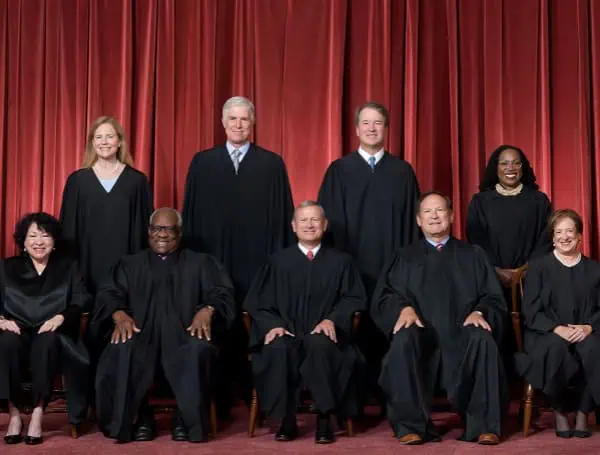
High Court’s Big Week: Religious Opt-Outs, Limited Injunctions, And Digital Age Gates
Conservative Majority Shapes New Legal Landscapes on Faith, Federal Reach, and Free Speech
The U.S. Supreme Court concluded a consequential week by issuing several significant rulings that touched upon religious freedom in public education, the scope of nationwide injunctions, and the regulation of online adult content.
These decisions, largely splitting the court along ideological lines, are poised to have far-reaching implications for American law and society.
Parental Rights and Religious Objections in Schools
In a closely watched case, the Supreme Court sided with a group of Maryland parents in a dispute over public school instruction on gender and sexuality. The 6-3 decision, with the Court’s Republican appointees forming the majority, affirmed the parents’ right to seek preliminary injunctions allowing them to opt their elementary school children out of instruction they believe violates their religious beliefs.
Justice Samuel Alito, writing for the majority, emphasized that the government cannot condition public education on parents’ acceptance of instruction that poses “a very real threat of undermining” the religious beliefs they wish to instill. He stated that the parents are “likely to succeed” in their argument that the school board’s policies “unconstitutionally burden their religious exercise.”
Conversely, Justice Sonia Sotomayor, writing for the dissenting Democratic appointees, warned that the ruling ushers in a “new reality” that could lead schools to “censor their curricula, stripping material that risks generating religious objections.”
She argued that the majority’s decision “hands a subset of parents the right to veto curricular choices long left to locally elected school boards.” The case centered on parents seeking notice and an opt-out for instruction involving books featuring LGBTQ characters, rather than a ban on the materials themselves. School officials in Montgomery County had cited concerns about student absenteeism, administrative infeasibility, and the potential for stigmatizing LGBTQ students as reasons against broad opt-out policies.
Curbing Nationwide Injunctions in Birthright Citizenship Case
In another significant 6-3 ruling, the Supreme Court sided with the Trump administration in curbing nationwide injunctions that had been granted against its executive order seeking to restrict birthright citizenship. While the Court did not rule on the underlying legality of President Trump’s order, it found that “universal injunctions” likely exceed the equitable authority granted to federal courts by Congress.
Justice Amy Coney Barrett, writing for the majority, stated that the Trump administration’s order on birthright citizenship would take effect in 30 days, while litigation on the core issue continues in lower courts. The decision leaves open the possibility for plaintiffs to bring class action lawsuits, but their success remains to be seen. Justice Samuel Alito, in a concurring opinion joined by Justice Clarence Thomas, stressed the need for courts to strictly police requirements for class actions and relief granted to third parties.
Justice Sonia Sotomayor, in a scathing dissent, accused the Court of rewarding the administration’s “gamesmanship,” arguing that the administration sought to limit injunctions without defending the constitutionality of its policy. Justice Ketanji Brown Jackson, in her own dissent, called the decision an “existential threat to the rule of law,” asserting that it allows the Executive to violate the Constitution against anyone who has not yet sued. The 14th Amendment’s citizenship clause, central to the underlying dispute, states that “All persons born or naturalized in the United States, and subject to the jurisdiction thereof, are citizens.”
Age Verification Upheld for Online Adult Content
The Supreme Court also concluded the term by ruling against the adult entertainment industry in a First Amendment case involving pornography. In a 6-3 decision authored by Justice Clarence Thomas, the Court affirmed a state’s authority to require age verification to prevent children from accessing explicit online content.
The case involved a Texas law challenged by an adult industry trade group, which argued the verification process unduly burdened adults’ access to legal content. The Court rejected both “strict scrutiny” and “rational basis” review, instead applying an intermediate level of scrutiny, finding that the law “advances the State’s important interest in shielding children from sexually explicit content.”
Justice Elena Kagan, dissenting for the Democratic appointees, argued that the law should have been subjected to “strict scrutiny” because it “covers speech constitutionally protected for adults; impedes adults’ ability to view that speech; and imposes that burden based on the speech’s content.” She expressed concern that the majority undervalued free expression rights.
These rulings mark a significant week for the Supreme Court, shaping ongoing debates on religious freedom, executive power, and online speech in the United States.
MORE ARTICLES - TAMPA FREE PRESS
- Texas Triumphs: GOP Bill Scraps Silencer & SBR Taxes
- Trump’s “Junk” Jibe Fuels Green Energy Tax Credit Cuts In “Big, Beautiful Bill”
- Florida And Texas Age Verification Laws Gain Supreme Court Backing
- Senate Republicans Push Forward On Trump’s Big Beautiful Bill In Dramatic Saturday Vote
- Louisiana Sen. John Kennedy: Jackson’s “Mad As A Bag Of Cats” Dissent Proves Court Got It Right
- Bronx Born… Or Yorktown Raised? AOC’s “Silly Girl” Taunt Gets A Suburban Fact Check
- Shattered Hard Drive Hints At Cover-Up In Washington Post Journalist’s Criminal Case: FBI
- Alan Dershowitz Says Trump Can Legally “Ignore” Liberal Judges’ Injunctions
TAMPA FREE PRESS
Please make a small donation to the Tampa Free Press to help sustain independent journalism. Your contribution enables us to continue delivering high-quality, local, and national news coverage.
Android Users: Download our free app to stay up-to-date on the latest news.
Connect with us: Follow the Tampa Free Press on Facebook and Twitter for breaking news and updates.
Sign up: Subscribe to our free newsletter for a curated selection of top stories delivered straight to your inbox.