
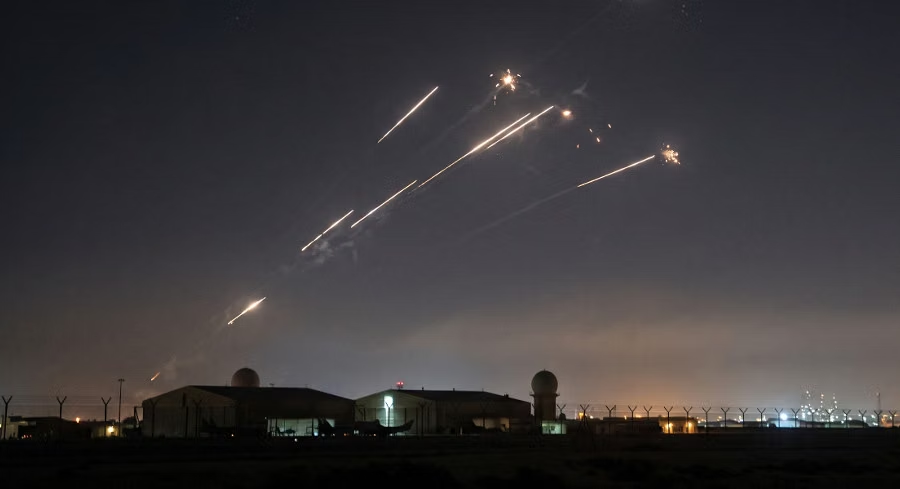
Third Iranian Drone Strike In Five Days Targets U.S. Base In Bahrain
Air defenses over Bahrain intercepted a fresh wave of Iranian drones early Tuesday morning, marking the third aerial strike aimed at U.S. military sites in the island kingdom in just five days.
Iran’s Islamic Revolutionary Guard Corps took credit for the Tuesday, November 17 operation, stating its forces aimed at an American-run radar system located at Sheikh Isa Air Base. According to Bahraini officials, local air defense batteries successfully knocked down the incoming aircraft before they could hit their mark. U.S. Central Command confirmed that no American troops were hurt and no military gear was damaged in the incident.
During the morning scare, Bahrain’s Interior Ministry pushed out emergency alerts warning citizens of a possible aerial threat and telling residents to take shelter while defense crews engaged the drones.
This latest barrage follows similar strikes on Friday and Sunday, shattering a multi-week lull in direct attacks against the country. Military officials in Tehran framed Tuesday’s operation as payback for ongoing U.S. surveillance flights and alleged violations of Iranian airspace. For months, the Revolutionary Guard has accused Washington of using bases in neighboring Arab states as staging grounds for operations against Iran, part of a wider regional conflict involving the U.S., Iran, and Israel that first erupted on February 28.
Bahrain sits at the center of American military logistics in the Persian Gulf. Beyond hosting the headquarters for the U.S. Navy’s Fifth Fleet—which patrols the Gulf of Oman and surrounding waters—the small nation houses vital communications hubs and radar arrays. Because those radar systems provide early warnings against incoming missiles and aircraft, military planners consider them high-value targets. The string of strikes has sparked fresh worry that American outposts in other Gulf nations could soon face similar drone campaigns.
U.S. Central Command (USCENTCOM,X)
The escalating aerial clashes are unfolding alongside growing chaos at sea. Just miles away in the Strait of Hormuz, a vital chokepoint for global oil and natural gas shipments, security continues to unravel. Reuters reported Tuesday that crew members from a commercial tanker were missing after a separate maritime incident in the strait. Regional governments are watching closely, as sustained disruption in the waterway threatens to drive up international shipping rates, insurance premiums, and global energy prices.
Even as drones fly over the Gulf, diplomats are still trying to broker a way out of the fighting. Officials from Oman and Qatar have been acting as go-betweens to lower temperatures and secure shipping lanes. Qatari officials noted that representatives from Tehran and Doha were scheduled to sit down in Qatar’s capital on Tuesday to keep those talks alive.
Still, the back-and-forth strikes show just how uphill that diplomatic climb remains, with Tehran insisting its operations are defensive retaliation while Washington maintains its forces are facing unprovoked Iranian aggression.