
The Pentagon Misplaced $1.3 Billion In F-35 Parts—And The Real Tab Could Hit $2.5 Billion
Imagine running a $31 billion global supply operation spanning more than 700 warehouses and bases, yet having no reliable, real-time way to know which expensive fighter jet parts are actually sitting on the shelves. According to federal auditors, that is the exact predicament facing the Pentagon’s F-35 stealth fighter program.
A new Government Accountability Office review reveals that the F-35 Joint Program Office failed to record roughly 17,000 spare parts—from jet engines to tires—valued at about $1.3 billion in its official property tracking system. Defense Department officials admitted to the watchdog that the true bill for those unlogged components, which were sitting in repair shops, awaiting maintenance or moving between facilities, could soar as high as $2.5 billion once shipping, overhead, and missing cost figures are tallied.
Conducted between September 2025 and November 2026 under a Title 31 statutory mandate to audit the federal government’s consolidated financial statements, the investigation took auditors to Edwards Air Force Base in California, Hill Air Force Base in Utah and Marine Corps Air Station Cherry Point in North Carolina. GAO financial management director Asif A. Khan sent the findings to key House and Senate armed services and oversight committees.
“The approximately $1.3 billion involved represents a significant amount of government property that was not recorded and adequately supported in DOD’s accountable property system,” a GAO representative said. Because the Enterprise Logistics Management System does not reflect real-time changes and lacks proper data validation rules, auditors warned, defense leaders are flying blind when it comes to financial reporting and keeping troops ready for combat. Even physical inventory checks fell short, failing to properly verify that parts actually existed or confirm that records were complete.
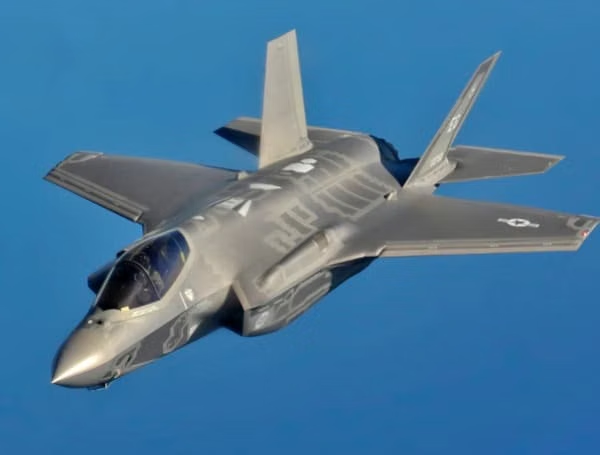
An F-35A takes off from Hill Air Force Base, Utah, March 14, 2014. After getting upgrades, the F-35A is on its way back to Nellis AFB, Nev. (U.S. Air Force photo by Airman 1st Class Joshua D. King/ RELEASED)
At the heart of the bookkeeping breakdown is a massive digital and procedural disconnect. The F-35’s global supply network holds roughly 26 million government-owned parts worth $31 billion across more than 700 contractor- and government-managed facilities worldwide. While major defense contractors kept their own separate records for the 17,000 unlogged components, those files were frequently inaccurate or incomplete and were never routinely fed into the military’s central software. Auditors first flagged these data-validation blind spots back in 2022 under an open recommendation that remains unresolved.
Even more troubling, as of March 2026, the Joint Program Office still did not know the status of more than 1 million lost F-35 parts—valued at over $85 million—that the GAO first highlighted in 2023. Without a formal system to review loss reports from government-run facilities, auditors noted, the Pentagon cannot gauge the true scale of missing gear or effectively spot fraud, waste and theft.
Much of the confusion comes down to human oversight: the program office has never built a mature property accountability framework, leaving accountable property officers without the F-35-specific training or written playbooks they need to do their jobs. While the Pentagon is developing new rules to assign dollar values to parts with missing cost data so they can finally appear on agencywide financial statements, those policies are still under review.
Pressed on the audit, an F-35 Joint Program Office spokesperson said officials are modernizing their tracking infrastructure by building direct, real-time data links between government computers and prime contractor networks, alongside rolling out sharper loss analysis and staff training. Prime contractor Lockheed Martin referred specific questions about the report back to the military office. A company spokesperson said Lockheed works with U.S. military branches, international allies and suppliers to speed up repair turnarounds and boost part availability, adding that a proposed multiyear purchasing and sustainment deal would give suppliers the predictability they need to expand production capacity.
To fix the accounting gaps for good, the GAO issued four formal recommendations directing the Secretary of Defense to work with acquisition leaders, the F-35 Program Executive Officer and the Defense Contract Management Agency. The watchdog called on the Pentagon to set up procedures for monitoring loss submissions and running trend analyses to prevent future losses, write F-35-specific guidelines for accountable property officers, create dedicated training for those staffers and clearly define the officer program’s structure—including how many officers are needed, where they should work and how much time their duties require. Defense officials concurred with all four recommendations and noted that the program office is already drafting the new rules and training plans.
This bookkeeping trouble arrives at a difficult moment for the $1.9 trillion F-35 program, the costliest weapons project in U.S. history. More than 800 of the stealth fighters fly across three U.S. variants—including models designed to land vertically and carry nuclear weapons—alongside fleets operated by roughly 20 allied nations. Testifying before Congress in June 2026, program chief Lt. Gen. Gregory Masiello praised the jet for proving its combat value as a “quarterback” during U.S. operations against Iran, but conceded that a repair and supply chain built for a much smaller fleet simply cannot keep up. Because of those bottlenecks, the F-35 fleet can currently carry out all of its assigned missions just 25% of the time, well short of the military’s 65% goal for 2030. Factory slowdowns have only added to the strain, leaving every single one of the 110 jets delivered in 2024 arriving an average of 238 days—nearly eight months—late.
Adding to the scrutiny, the GAO report landed alongside an unrelated Pentagon investigation into how F-35 parts shipped from Australia to the United States ended up in Hong Kong, raising acute security concerns that the jet’s sensitive technology could be exposed to Beijing. While auditors did not link that security scare to the domestic accounting errors, they warned that the tracking failures threaten to complicate the Global Support Solution Reset. Launched in mid-2025, that sweeping sustainment overhaul calls for roughly $13.7 billion in extra funding through fiscal year 2031—money that will be tough to manage if the Pentagon cannot verify which spare parts it already owns or needs to buy.