
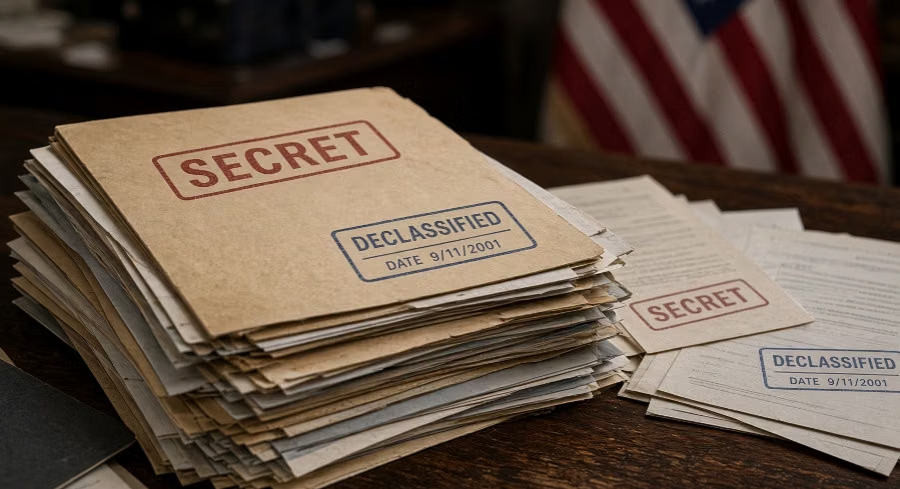
Declassified CIA Memos Show Years Of Warnings On Bin Laden Before 9/11
Newly declassified intelligence records reveal that the United States received detailed warnings about Osama bin Laden and planned extremist attacks starting roughly three years before the September 11 tragedy.
The Central Intelligence Agency declassified 71 memos spanning 101 pages on Friday. The collection covers intelligence provided during both the Clinton and George W. Bush administrations, tracking bin Laden, the Taliban, and Afghanistan’s opium trade.
The earliest records in the release date back to early 1998. A February 13, 1998 memo warned that bin Laden and other extremists had met to procure chemical, biological, and nuclear substances on open markets, while also agreeing to expand narcotics trafficking to Europe and the U.S. using legitimate businesses.
Later that month, on February 24, intelligence tracked a fatwa signed by bin Laden calling on Muslims to attack American interests and civilians worldwide until the U.S. withdrew from Saudi Arabia and Palestine. By March 5, 1998, a counterterrorism memo highlighted threats from a group called the “Three Brothers Islamic Front” to detonate explosives in Montreal and New York.
The release also includes a detailed situation report prepared on September 12, 2001, summarizing initial assessments following the hijackings.
According to the document, Sunni extremists in Afghanistan and the Persian Gulf were aware that bin Laden-directed operations were imminent. The report noted that bin Laden had recently clashed with Taliban leader Mullah Omar over his plans, telling Omar he had operations underway that would cause great damage to the United States.
A Kandahar-based source cited in the document stated the attacks were the result of two years of planning and represented “the beginning of the wrath.” Intelligence gathered in the immediate aftermath also showed early confusion among sympathizers over the targets; one individual in Kuwait offered thanks for “the explosion in the Congress building,” and a sympathetic group member initially claimed the White House was destroyed before correcting himself. The memo also identified a operative named al-Ghamdi who may have boarded United Airlines Flight 175.
The September 12 report captured the rapid global fallout across military, transportation, and financial sectors. Mullah Omar fled his Kandahar residence, while United Nations agencies made plans to pull staff out of Afghanistan by car over fears of air travel bans and U.S. retaliation. The North Atlantic Council met in an emergency session, while Russia raised the alert level for its air defense, space, and naval forces.
Airports across North America shut down, prompt flight suspensions to the Middle East, and led the UK and Belgium to close airspace over London and Brussels. Major Asian stock markets saw steep drops, including a 700-point fall in Japan’s Nikkei index, while European aviation stocks fell sharply. Oil prices briefly pushed past $31 a barrel before Brent crude settled at $29.06 per barrel, with exports from Saudi Arabia, Kuwait, and Iraq remaining stable.
Beyond the financial and transportation disruptions, the memos detailed widespread geopolitical instability in the hours immediately following the attacks.
In Afghanistan, the anti-Taliban Northern Alliance launched overnight assaults on Kabul, seeking to demonstrate that its military capabilities remained intact following the September 9 assassination of its leader, Ahmad Shah Massoud. Meanwhile, international security alerts expanded rapidly across Asia, including the temporary evacuation of the Petronas Twin Towers in Malaysia following a phoned bomb threat, while airlines such as Australia’s Qantas began rerouting international flights away from Afghan airspace entirely.
The declassified records also noted that ongoing Middle East conflict remained volatile during the same period. Intifada-related clashes persisted across the West Bank and Gaza Strip, where mortar rounds and rocket-propelled grenades drew Israeli tank and gunfire, resulting in six reported Palestinian deaths overnight.
Taken together, the release illustrates how intelligence agencies tracked the growing intersection of bin Laden’s financial empire, his operational dependence on the Taliban, and his years-long pursuit of global attack capabilities leading up to September 2001.