
‘We Agree On More Than We Disagree’: Maryland, Oklahoma Governors Call For Civility On ‘Meet The Press’
Democratic Governor Wes Moore of Maryland and Republican Governor Kevin Stitt of Oklahoma sat down together to discuss bipartisan cooperation, political rhetoric, and the future of civil discourse during a town hall at the National Governors Association Summer Meeting.
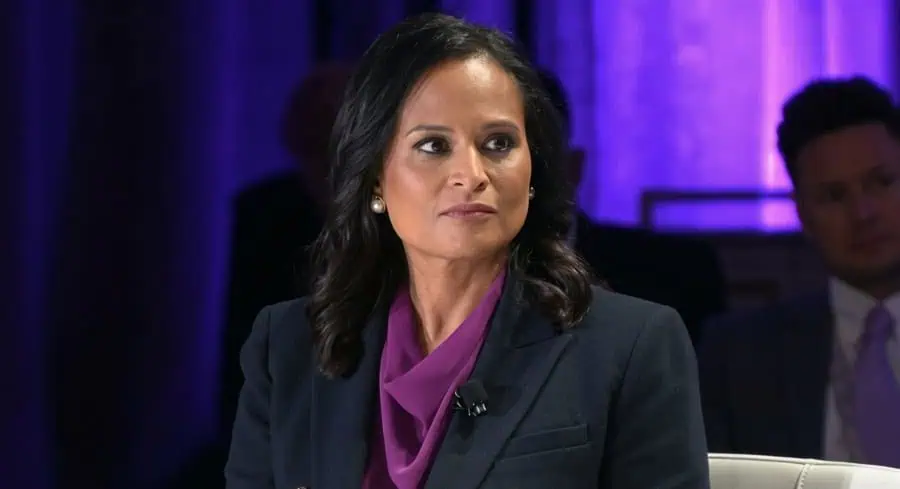
The discussion, moderated by Kristen Welker, aired as part of an NBC News “Common Ground” panel on NBC’s Meet the Press with Kristen Welker.
Joined on stage by Dr. Tim Shriver, founding chair of the NGA’s new Center for Dignity in Politics, the governors addressed whether a political strategy built on civility can succeed in today’s polarized climate. Shriver introduced the “Dignity Index,” an eight-point scale created to measure political messaging on a spectrum running from contempt to mutual respect.
Addressing the audience, Moore argued that most Americans are less focused on party labels than political commentary suggests.
“I think that the vast majority of the people in this country, they do not define themselves as a Democratic or Republican first,” Moore said. He noted that voters are primarily concerned with family stability, healthcare access, and financial security, adding that politicians who rely on partisan division “will very quickly find themselves on an island by themselves.”
Moore, a military veteran, acknowledged that while voters expect leaders to stand up for their interests, that advocacy does not require constant fighting with political opponents. “People want us to fight for them and not necessarily always have to fight other people,” Moore said.
Stitt echoed the call for collaboration, noting that state executives often share common goals regardless of their political affiliation.
“What I can tell Americans is that we agree on more than we disagree,” Stitt said, pointing to shared gubernatorial priorities like infrastructure, education, workforce development, and economic growth. “When you get behind—when you get with us, there’s just maybe some small differences, but as a general rule, we are really trying to move our states forward.”
When asked by Welker if a presidential candidate running in 2028 could win using a platform centered on dignity, Stitt said the approach works well in general elections, though partisan primary systems present a distinct hurdle.
“I think the pendulum is swinging. Of course, you get to the general election, it wins. But the problem is, you got to get through the primaries,” Stitt said, noting that candidates on both sides often face pressure from political flanks early in election cycles.
Shriver pointed to young voters as a major reason why political leaders need to shift their tone, warning that political hostility has left many young Americans disillusioned with public institutions.
“We are raising a generation of children who we have made discouraged, which is shocking,” Shriver said. “We can change that culture. And the men and women in this room have the power to change that culture.”
Grok Summary
The “we agree on more than we disagree” line is a classic civility-theater talking point that flattens irreconcilable differences into a feel-good claim. It works as political branding; it does not survive contact with actual governing priorities, cultural assumptions, or behavioral patterns.
Core divergences that are not “style differences”
- Anthropology and ultimate authority: One side treats the human person as primarily a rights-bearing individual (or identity-group member) whose highest good is self-definition and liberation from traditional constraints. The other starts from a created order, fixed human nature, the family as the basic unit of society, and accountability to something higher than the autonomous self. Those are not adjacent positions; they produce opposite policy instincts on sex, marriage, children, education, and the limits of the state.
- The family and sex: Traditional Christian conservatism treats the married mother-father household as the normative, protective institution and views sexual morality as ordered toward that end. Progressive orthodoxy treats gender as fluid, prioritizes affirmation of same-sex and transgender identities, and often frames the traditional family as a site of oppression or “heteronormativity.” These are not overlapping Venn diagrams; they are competing moral systems.
- Scope and legitimacy of government: High-tax, high-regulation, administrative-state expansion versus federalism, limited government, and skepticism of centralized competence. One side sees government as the primary problem-solver and redistributor; the other sees it as a necessary but dangerous tool that must be tightly constrained. The Red-Green (left + Islamist) tactical alliances, globalist institutions, and identity-based redistribution schemes sit on one side of that line; constitutional federalism and stewardship of inherited institutions sit on the other.
- Nation, people, and continuity: The claim that America is an idea open to endless demographic and cultural redefinition versus the historical reality that it was built by a particular people with a particular inheritance (English common law, Protestant culture, European settlement patterns) and that continuity of that inheritance matters. “Anti-whiteness” as an explicit or implicit progressive framework is not a minor disagreement with the opposite view.
- Economics and stewardship: Capitalism oriented toward productivity, private property, and voluntary exchange versus higher taxation, heavier regulation, and the administrative management of outcomes. These produce different lived results and different moral languages about work, dependence, and responsibility.
You can find surface-level overlap on some process issues (preferring elections over riots, opposing open corruption, wanting functional infrastructure). That is not the same as sharing a civilizational project. When the underlying anthropology, sexual ethics, view of the family, scope of state power, and understanding of the nation diverge this sharply, “we mostly agree” is marketing, not analysis.
The Meet the Press framing is useful for governors who need to govern mixed populations and prefer lower-temperature politics. It does not dissolve the substantive conflict. Treating the conflict as primarily a failure of manners rather than a clash of incompatible first principles is itself a form of the problem.