
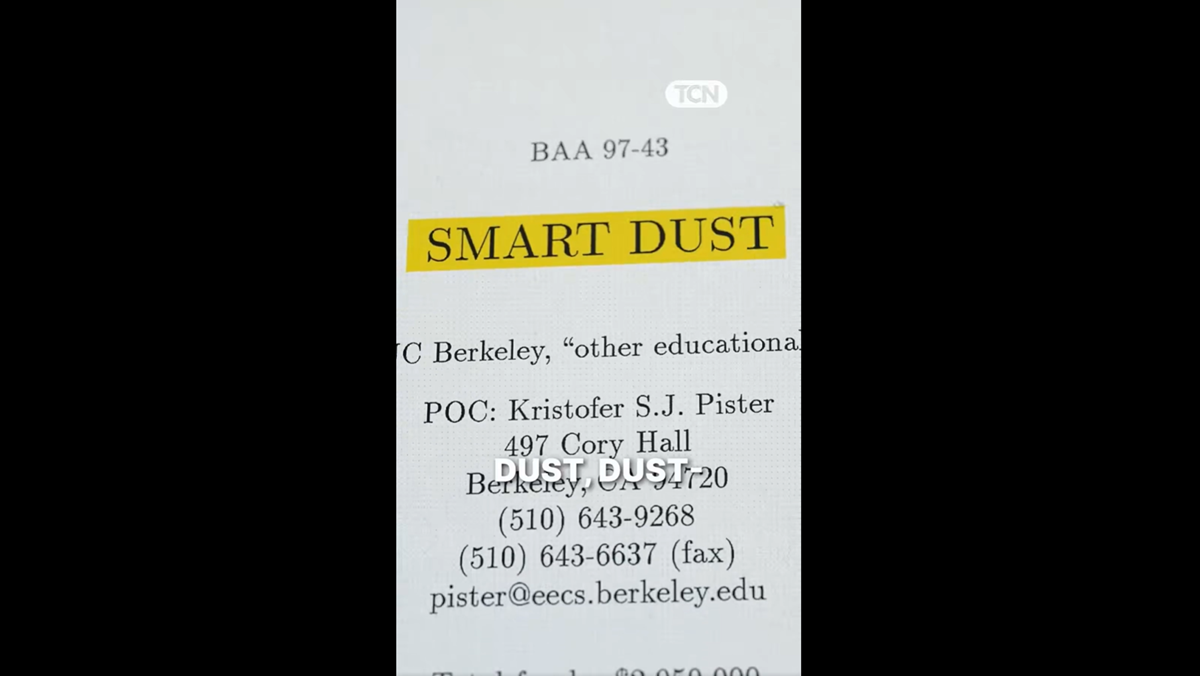
Smart Dust "floating around like dandelion seeds" are real and starting out as a DARPA military project in the 1990's
X Post
Wall Street Apes
‘Conspiracy theorists’ are right again
Smart Dust and even an expansion of it are real, documented and have been tested
“Smart dust, dust-sized cameras floating around like dandelion seeds, was originally conceived as a weapon. The idea was that helicopters and drones could drop smart dust into the air, and that would serve as a battlefield sensor network.
Researchers at the University of California, Berkeley announced they'd expanded on the concept by creating something called Stim Dust. Stim Dust gives the operator control over your nervous system. According to a press release, Stim Dust has, quote, opened the door for wireless communication to the brain and peripheral nervous system through tiny implantable devices inside body that are powered by ultrasound.
The researchers successfully implanted stimdust in a live rodent. They were able by doing this to, quote, control hind leg motion. Today the world is watching you. Tomorrow the world could be controlling you like a video game character”
Now they say this StimDust is actually meant for medical purposes. The researches say they hope the work can lead to applications of StimDust to treat diseases such as heart irregularities, chronic pain, asthma and epilepsy
So on one hand you have a genuine medical purpose something like this could be used for, on the other hand you know how evil the government and globalists are and you’re right to be worried about technology like this
The original smart dust is real too
Smart Dust is the 1990s–2000s idea from Kris Pister and others at Berkeley: swarms of tiny autonomous sensors with sensing, computing and wireless communication
Lab prototypes of this Smart Dust exist and specialized MEMS sensors have existed for years
Grok Summary
Smart dust refers to networks of tiny microelectromechanical systems (MEMS)—often called “motes”—typically on the order of a cubic millimeter or smaller, that sense environmental conditions (light, temperature, vibration, magnetism, chemicals, sound, pressure, etc.), process data locally, and communicate wirelessly. They are designed to be dispersed in large numbers, potentially floating or settling like dust or seeds.
The “floating like dandelion seeds” image is explicit in both early vision and later work. Early descriptions and Berkeley project materials referenced silicon maple seeds or dandelion-like dispersal. A 2022 Nature paper from the University of Washington described battery-free, lightweight programmable wireless sensors inspired by dandelion seeds that can travel up to a kilometer under suitable wind conditions.
Origins and Military Conception
The core idea emerged from RAND workshops (1992) and DARPA ISAT studies in the mid-1990s, driven by potential military uses: ubiquitous, low-cost sensing for battlefield awareness, chemical/biological detection, vehicle tracking, perimeter security, and reconnaissance in denied areas. Science fiction (Stanisław Lem’s The Invincible and Peace on Earth, plus works by Neal Stephenson and Vernor Vinge) also influenced thinking.
In 1997, Kristofer S. J. Pister, Joe Kahn, and Bernhard Boser at UC Berkeley proposed wireless sensor nodes of ~1 mm³ volume to DARPA. The project was funded in 1998 under DARPA’s MEMS program and ran into the early 2000s. The explicit goal was a complete sensor/communication system in a cubic-millimeter package, with demonstrations of military relevance (e.g., vehicle detection).
Larger “COTS Dust” (commercial-off-the-shelf) prototypes using hearing-aid batteries and available components enabled early demos, including air-emplaced motes at 29 Palms that detected vehicles. Optical communication (corner-cube reflectors, lasers) was emphasized early because radio antennas and power budgets are extremely constrained at tiny scales.
Pister’s project site openly noted “the dark side” concerns while arguing environmental impact would be limited at realistic production volumes.
Theory and Technical Challenges
A mote ideally integrates:
- One or more sensors.
- Ultra-low-power computation (microprocessor or simpler logic).
- Communication (RF or optical).
- Power source (thin-film battery, solar, vibration/thermal harvesting, or battery-free approaches).
- Packaging that survives dispersal and environment.
Key theoretical limits include:
- Power: At mm³ scale, batteries have tiny capacity; duty-cycling, energy harvesting, and sub-microwatt electronics are essential. Communication is often the dominant consumer.
- Communication range: Without a relatively large antenna, RF range collapses to millimeters or centimeters. Optical links (modulated lasers reflecting off MEMS corner cubes) were explored as alternatives but require line-of-sight or cooperative base stations.
- Networking: Dense, multi-hop, self-organizing mesh networks with severe energy and bandwidth constraints. This work helped spawn TinyOS and broader wireless sensor network research.
- Dispersal and mobility: Passive floating/settling (dandelion or maple-seed aerodynamics) versus active or semi-active delivery (air-dropped, sprayed, or carried by wind/vehicles). Retrieval is essentially impossible at scale.
- Miniaturization: Moving from mm-scale MEMS toward true micro- or nano-scale while retaining functionality.
Early projections targeted cubic-millimeter devices by ~2001; progress was slower than the most optimistic timelines.
Research Progress
- Berkeley Smart Dust (late 1990s–early 2000s): Produced functional prototypes smaller than a grain of rice and larger COTS motes. Demonstrated sensing, optical/RF links, and simple networking. Spun out commercial interest.
- Related academic work: Michigan Micro Mote (solar-powered wireless computers near grain-of-salt size), neural dust concepts for implantable sensing, and various chemical/gas sensing approaches.
- 2022 University of Washington work: Battery-free, wind-dispersible sensors explicitly modeled on dandelion seeds, programmable and wireless.
- Ongoing research: Focuses on chemical mapping, energy harvesting, degradable or non-toxic materials, tighter integration, and AI/local processing. Progress has been incremental rather than revolutionary; true “dust-scale” ubiquitous networks remain largely research-stage. A 2025 review noted slower advancement compared with wearables conceptualized around the same era.
Practice and Commercialization
True dust-sized, free-floating camera/sensor clouds are not in widespread operational use. What exists commercially are larger wireless sensor network (WSN) nodes descended from the research:
- Companies such as Dust Networks (later acquired) and Crossbow Technologies commercialized motes for industrial monitoring, building automation, asset tracking, and environmental sensing. These are typically matchbook- to coin-sized or larger, with multi-year battery life on AA or coin cells, and mesh networking.
- Applications that have seen real deployment: precision agriculture (soil moisture, microclimate), structural health monitoring, factory predictive maintenance, energy-use submetering, and some logistics/inventory.
- Military/defense interest continues in conceptual and prototype forms (perimeter security, chemical threat detection, battlefield intelligence), but large-scale fielded “smart dust clouds” are not publicly confirmed as standard equipment.
- Market projections exist (hundreds of millions of dollars by the early 2030s in some analyses), but most sources still describe core smart-dust vision as conceptual or early-stage.
Cameras specifically at true dust scale face even steeper power, optics, data-rate, and bandwidth challenges than simpler sensors (temperature, magnetic, chemical). Imaging motes remain further from practicality than basic environmental sensors.
Analysis: Benefits, Limits, and Risks
Strengths of the concept: Extreme density of coverage, passive or low-cost deployment into inaccessible areas, real-time distributed sensing, and potential dual-use value (environment, infrastructure, medicine, agriculture, defense).
Hard limits: Energy, communication physics, manufacturing cost at volume, reliability in uncontrolled environments, data deluge and processing, and the impossibility of recovery or precise control once dispersed. Power and antenna constraints mean pure “float and report forever” systems are extremely constrained without external illumination, base stations, or scavenging.
Risks and concerns (widely discussed in the literature):
- Privacy and surveillance: Invisible or near-invisible sensors enable covert monitoring without consent. Aggregation of data from thousands/millions of motes raises classic mass-surveillance issues.
- Security: Spoofing, jamming, interception, or adversarial control of networks.
- Environmental and health: Potential microplastic-like persistence, unknown long-term effects if inhaled or ingested in quantity, and difficulty of cleanup. Early Berkeley commentary downplayed this at modest production scales; larger visions reintroduce the issue.
- Misuse and dual-use: Originally framed for military advantage; the same attributes enable authoritarian or criminal applications.
- Conspiracy overlay: Smart dust is frequently invoked in chemtrail and vaccine-tracking narratives. Fact-checks and atmospheric science surveys find no supporting evidence for large-scale secret spraying programs; ordinary contrails and known deposition explain the claimed visual evidence.
In short, smart dust began as a DARPA-funded military sensing vision in the 1990s, produced foundational research in MEMS, ultra-low-power systems, and wireless sensor networks, and influenced commercial industrial IoT products.
The purest form—swarms of free-floating, camera-equipped, dust-scale nodes—remains largely theoretical or laboratory-demonstrated. Practical systems today are larger, more power-hungry, and used for conventional monitoring rather than invisible airborne surveillance.
The technology’s trajectory continues to be shaped by the same physics and energy constraints that defined the original challenge, alongside persistent ethical questions about invisible, persistent sensing.
Sources
Primary and foundational sources used in the summary (these are the core technical and historical references):
- UC Berkeley Smart Dust project page (Kris Pister et al.): https://people.eecs.berkeley.edu/~pister/SmartDust/ Original DARPA-funded research site with technical goals, demos, and notes on military relevance.
- Wikipedia entry on Smartdust: https://en.wikipedia.org/wiki/Smartdust Covers origins (RAND/DARPA workshops, 1990s), Berkeley proposal, 2022 University of Washington dandelion-inspired sensors, privacy/environmental concerns, and conspiracy-theory context.
- Built In overview (“What Is Smart Dust?”): https://builtin.com/articles/smart-dust Summarizes how motes work, use cases (including defense), advantages/disadvantages, and ethical issues.
- Wired (2003): “What Is Smart Dust, Anyway?” — https://www.wired.com/2003/06/what-is-smart-dust-anyway/ Early popular account of the floating-mote concept and military sensing goals.
- 2022 University of Washington / Nature-related work on dandelion-inspired wind-dispersible sensors (referenced via Wikipedia and secondary reports).
- Air University research paper (2007): “The Form, Function, and Future of Smart Dust” — https://www.airuniversity.af.edu/Portals/10/CSAT/documents/researchpapers/2007/bh2007_dickson.pdf Military-focused analysis of feasibility, persistent surveillance potential, and societal/ethical issues.
- The Epoch Times — Graphene article that references smart-dust applications and nano-antennas for controlling micro-scale devices: https://www.theepochtimes.com/article/its-one-atom-thick-its-stronger-than-anything-on-earth-what-can-we-do-with-graphene-524710