
Trump Announces Near-Total Destruction Of Iranian Military And Nuclear Capabilities
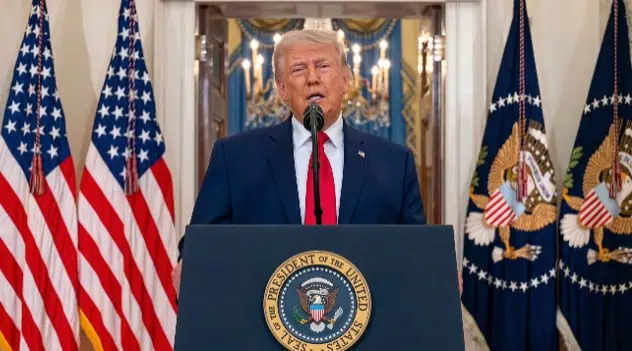
In a wide-ranging address from the White House on Wednesday, President Trump declared that the United States military has “eviscerated” the Iranian regime and secured a historic energy partnership with Venezuela, marking a dramatic shift in global geopolitics just one month into “Operation Epic Fury.”
The President opened his remarks by celebrating the successful launch of NASA’s Artemis II mission, which he noted would travel “very substantially past the moon” to distances never before reached by a manned rocket. However, the focus quickly shifted to the battlefield, where he detailed the rapid dismantling of Iran’s military infrastructure.
“As we speak this evening, it’s been just one month since the United States military began Operation Epic Fury,” the President said. “Our Armed Forces have delivered swift, decisive, overwhelming victories on the battlefield. Iran’s Navy is gone. Forces in ruins. Leaders, most of them… are now dead.”
According to the President, the 32-day campaign has decimated the command and control of the Islamic Revolutionary Guard Corps (IRGC) and “obliterated” key nuclear facilities using B-2 bombers. He emphasized that the strike was a preemptive necessity to prevent Iran from obtaining a nuclear weapon, a goal he vowed to uphold since his 2015 campaign.
“I will never let that happen,” he said, citing 47 years of Iranian hostility and recent intelligence that the regime was on the “doorstep” of a nuclear bomb. “This murderous regime also recently killed 45,000 of their own people… These terrorists who have nuclear weapons would be an intolerable threat.”
Turning to the Western Hemisphere, the President announced that U.S. troops had taken control of Venezuela “in a matter of minutes,” transforming the nation from a localized concern into a “true sense joint venture partner” for the United States. He highlighted the strategic importance of Venezuela’s natural resources, which boast the largest oil and gas reserves on Earth after the U.S.
“We are now totally independent of the Middle East,” the President stated. “We don’t need their oil. We don’t need anything they have, but we’re there to help our allies.” He added that between American domestic production—which he referred to as “drill, baby, drill”—and the new barrels coming from Venezuela, the U.S. now outproduces Saudi Arabia and Russia combined.
Despite the military success, the President acknowledged the human cost, honoring 13 American “warriors” who lost their lives during the month-long operation. He recounted recent visits to Dover Air Force Base, stating that the families of the fallen urged him to “finish the job.”
Addressing domestic concerns over rising gasoline prices, the President attributed the spike to “deranged terror attacks” by Iran against commercial tankers. He predicted that as the Strait of Hormuz “opens up naturally” following the conflict, energy prices would rapidly decline and the stock market would “roar back” to record highs.
While the President noted that “regime change was not our goal,” he observed that it has occurred effectively because the original leadership is “all dead.” He described the emerging leadership in Iran as “less radical and much more reasonable,” though he issued a stern warning that the U.S. remains prepared to strike electric generating plants if future agreements are not met.
“This military operation, so powerful, so brilliant against one of the most powerful countries… 32 days,” the President concluded, comparing the timeline to longer historical conflicts like Vietnam and Iraq. “The world is watching… the United States will be safer, stronger, more prosperous and greater than it has ever been before.”
The White House
[twitter-code url="https://twitter.com/WhiteHouse/status/2039508709374636457"]