
Louisiana And Virginia Senators Sound The Alarm On Social Security: Act Now Or Face 29% Cut
Two United States senators from opposite sides of the political aisle are warning that Congress must tackle Social Security’s finances now or risk automatic benefit cuts of nearly 29% in late 2032.
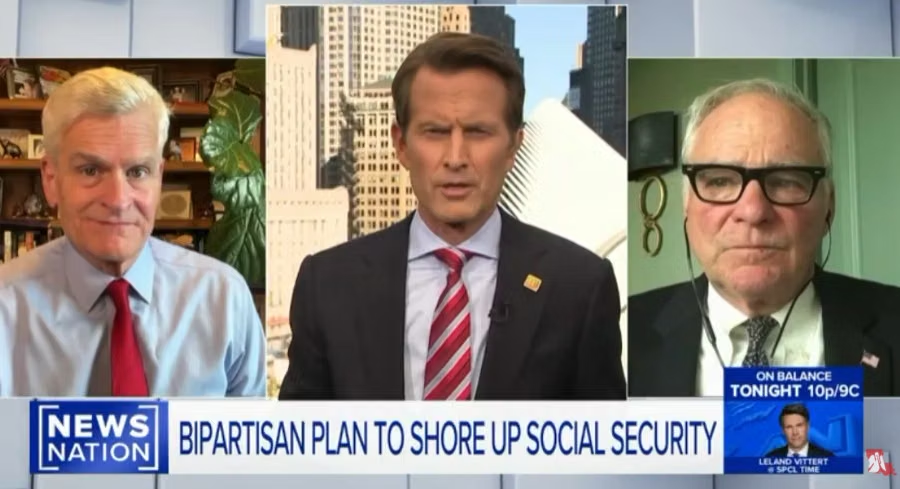
Appearing together on NewsNation, U.S. Sen. Bill Cassidy (R-LA) and U.S. Sen. Tim Kaine (D-VA) discussed a bipartisan concept aimed at stabilizing the program long-term. Under the framework, lawmakers would establish a separate investment fund to invest capital into the broader U.S. economy alongside the existing Social Security structure.
Cassidy explained that the proposal is modeled on the National Railroad Retirement Investment Fund and operates differently from past privatization pitches. Rather than creating individual accounts or tapping current trust fund reserves, the setup would use a collective fund that absorbs all market fluctuations on its own.
“Set up an investment fund like your 401k, parallel to the Social Security trust fund, put money into it and allow it to grow with the power of the US economy,” Cassidy said. “All risk is borne by the fund. It’s not an individual account; it’s a group account. But the beneficiary gets all the benefits that she’s been promised. If the stock market goes up or down, it doesn’t matter, she gets her benefits.”
Cassidy noted that over a 70-year timeline, returns from the fund could cover roughly 65% of obligations to retirees, potentially evergreening the program for future generations without continuous congressional intervention.
Kaine backed the concept during the broadcast, noting that sovereign and public retirement systems across the globe frequently use similar investment frameworks.
“Bill’s idea, which I enthusiastically embrace and support, is to take the existing Social Security framework where workers contribute and beneficiaries draw benefits, and add to it an investment fund whose earnings would come into the Social Security trust fund to bolster its solvency,” Kaine said. He projected that adding the fund could keep Social Security solvent for the next 50 to 75 years.
Both senators cautioned against waiting until the projected 2032 shortfall deadline to negotiate a fix. Cassidy noted that while lawmakers made small adjustments right before the 1983 deadline, stalling today carries far steeper consequences. Under existing law, mandatory cuts of almost 29% would hit beneficiaries if outlays exceed available revenue.
US Currency (File)
Cassidy also rejected proposals to simply borrow trillions to patch the shortfall, citing warnings from the Congressional Budget Office that unfunded borrowing of that scale would cause severe disruption to the broader American economy.
While Kaine admitted building broad support in Congress would likely move slowly, he stressed that starting discussions well ahead of the deadline offers lawmakers the best opportunity to find common ground.