
Four States Drag Trump Administration To Court Over Medicaid Work Mandate
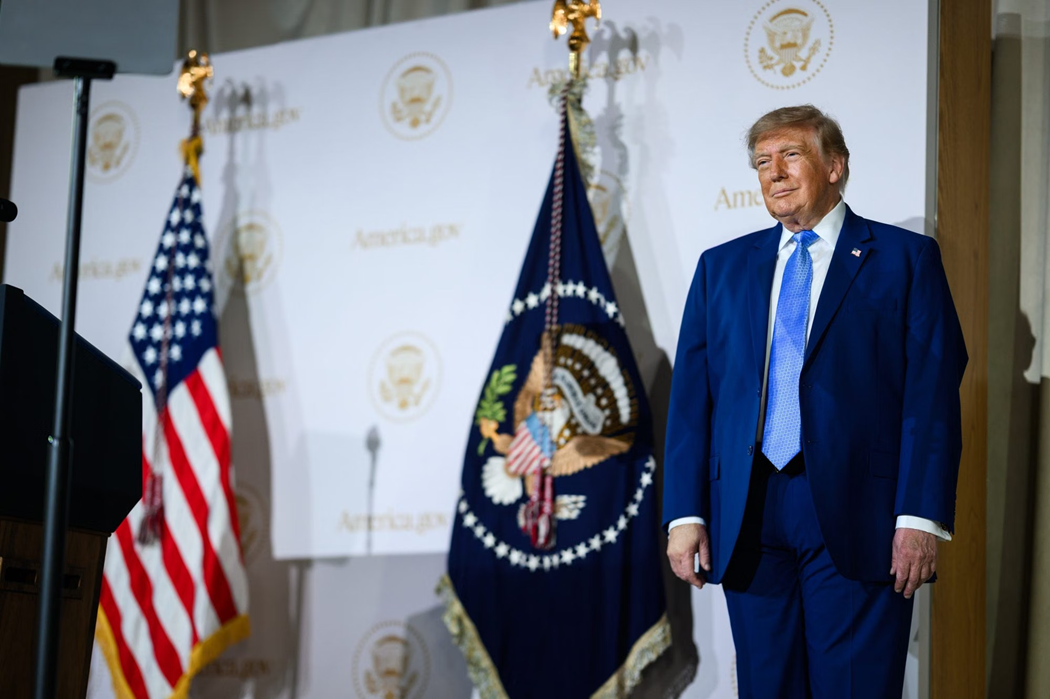
President Donald J. Trump delivers remarks on America.gov, a new AI-powered website for navigating federal government information and services, at the Andrew W. Mellon Auditorium in Washington, D.C., Tuesday, September 29, 2026. (Official White House Photo by Daniel Torok)
A legal showdown erupted Thursday as Minnesota and three other states filed a sweeping federal lawsuit to block mandatory Medicaid work rules before they take effect.
Minnesota Attorney General Keith Ellison, teaming up with his counterparts in Oregon, New Mexico, and Washington, argues the White House is holding state budgets hostage with an unconstitutional ultimatum: force low-income adults onto job rosters, or watch billions in federal healthcare dollars vanish overnight.
At the center of the crosshairs is a provision buried inside H.R. 1, dubbed the “One Big Beautiful Bill Act.” Scheduled to hit state rolls on Jan. 1, 2027, the mandate requires able-bodied adults ages 21 to 64 to log at least 80 hours a month on the job, in a classroom, or volunteering just to keep their health cards valid. States that drag their feet face the ultimate fiscal guillotine: total cancellation of their federal Medicaid funding.
Ellison did not pull his punches, blasting the mandate as a “bait-and-switch” maneuver that twists a 60-year-old safety net into an administrative trapdoor.

President Donald J. Trump makes remarks at a Hispanic Heritage Month Celebration in the East Room, Wednesday, September 30, 2026, at the White House. (Official White House Photo by Joyce Boghosian)
“Medicaid was built to keep poor people healthy, not to dangle doctor visits like carrots to make people punch a clock,” the lawsuit contends, warning that red tape—not a refusal to work—will be what actually pushes thousands out of doctors’ offices and straight into emergency rooms.
Behind the legal broadside lies a messy numbers game. While roughly 1.2 million Minnesotans rely on the state’s Medical Assistance program, officials cannot agree on how many heads are on the chopping block. Local reports peg the number of residents forced to verify work at 243,000, while the state’s own human services agency puts it closer to 128,000. Either way, state analysts predict as many as 140,000 people could fall through the cracks when the dust clears.
The core legal salvo targets what the coalition calls unconstitutional coercion. Medicaid began in 1965 as an equal-footing partnership between Washington and the states. By threatening to pull the rug out from existing budgets, the coalition argues, federal officials aren’t offering a choice—they’re holding a gun to state capitols.
The warning signs are not purely hypothetical. When Arkansas test-drove a nearly identical experiment in 2018, more than 16,000 people were purged from the rolls in just months before a federal judge pulled the plug. Post-mortems revealed the mandate did nothing to boost employment; instead, patients simply drowned in monthly paperwork and lost their insulin.
The Centers for Medicare & Medicaid Services clamped down on comment, noting it stays silent on pending lawsuits. But with billions on the line and the 2027 clock ticking, the court battle is set to decide whether access to an exam room can be traded for an 80-hour timesheet.