
What’s The Real Cost Of China? Regulators Pushed To Make U.S. Companies Tell All Ahead Of Trump-Xi Talks
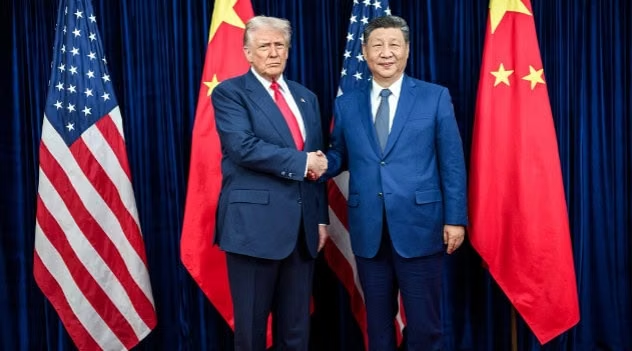
As President Donald Trump and Chinese President Xi Jinping prepare to meet this week, business and policy groups are turning up the heat on federal regulators to make companies come clean about how vulnerable they are to China.
The Coalition for a Prosperous America, a bipartisan group representing domestic manufacturers and producers, has joined a formal push urging the U.S. Securities and Exchange Commission to mandate that publicly traded corporations lay out those risks for everyday investors. The group threw its weight behind a petition first submitted in June by the Free Enterprise Project, an initiative of the National Center for Public Policy Research.
The petition asks the SEC to issue clear disclosure guidance for companies whose supply chains could shatter if relations between Washington and Beijing rapidly sour.
In a letter sent directly to SEC commissioners, CPA President Jonathan Toomey pointed to dangerous geopolitical flashpoints, including Beijing’s aggressive claims over Taiwan and the South China Sea.
“CPA has long held that U.S. investors are inadequately informed of the material risks of investments in publicly traded companies with supply chain reliance on and other entanglements with entities organized under the laws of, operating in, or otherwise engaged with the People’s Republic of China,” Toomey wrote.
President Donald J. Trump and Chinese President Xi Jinping
He warned regulators that shareholders are currently left in the dark about the exposure facing corporate America.
“None of the material risk presented by this precarious situation is currently conveyed to U.S. investors, whether institutional or individual,” Toomey added. “The Commission’s mandate is to assure that such risks are required to be communicated, in order to protect the integrity of U.S. capital markets.”
At the same time, the Free Enterprise Project is bypassing regulators and taking its questions straight to the private sector. The group has mailed letters to major U.S. banks and utility providers demanding details on how much Chinese-manufactured hardware sits inside the domestic electric power grid.
That outreach comes in the wake of an executive order from President Trump declaring a national emergency regarding foreign threats aimed at the country’s bulk-power system.
“Declaring a national emergency is a warning that cannot be ignored by corporate America,” said Steve Milloy, executive director of the Free Enterprise Project. “Banks and utilities need to know exactly where China-made equipment enters the U.S. power grid and what they are doing to address the risks before a potential vulnerability becomes an actual crisis.”
The SEC has not yet signaled whether it plans to act on the petition or issue new disclosure rules ahead of the bilateral talks.