
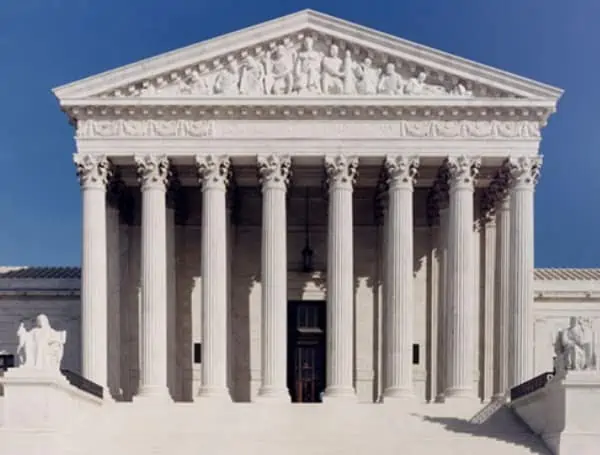
Supreme Court Sides With Catholic Charities In Wisconsin Unemployment Tax Exemption Case
The Supreme Court of the United States today delivered a unanimous decision in Catholic Charities Bureau, Inc., et al. v. Wisconsin Labor and Industry Review Commission et al., ruling that Wisconsin’s application of its unemployment compensation tax exemption to religious organizations violates the First Amendment. The Court found that Wisconsin’s interpretation of the statute imposed an unconstitutional denominational preference by differentiating between religions based on their theological practices.
The case centered on Wisconsin Statute §108.02(15)(h)(2), which exempts certain religious nonprofit organizations “operated primarily for religious purposes” and “operated, supervised, controlled, or principally supported by a church or convention or association of churches” from paying unemployment compensation taxes.
Catholic Charities Bureau, Inc., and four of its sub-entities, all controlled by the Roman Catholic Diocese of Superior, Wisconsin, sought this exemption.
However, the Wisconsin Supreme Court denied their request, holding that Catholic Charities was not “operated primarily for religious purposes” because it neither engaged in proselytization nor limited its charitable services to Catholics.
In the opinion of the Court, delivered by Justice Sotomayor, it was emphasized that the First Amendment mandates government neutrality between religions and subjects any state-sponsored denominational preference to strict scrutiny. The Court found that Wisconsin’s interpretation of the statute created such a preference.
“Petitioners’ eligibility for the exemption ultimately turns on inherently religious choices (namely, whether to proselytize or serve only co-religionists in the course of charitable work), not ‘secular criteria’ that ‘happen to have a “disparate impact” upon different religious organizations,’” Justice Sotomayor wrote, citing Larson v. Valente.
The Court noted that Catholic teaching prohibits proselytization during charitable acts and requires providing services “without making distinctions ‘by race, sex, or religion.’” Many other religions also impose similar rules, while some Protestant denominations, for example, have adopted a contrary approach, as highlighted by an amicus brief from Religious Liberty Scholars.
Wisconsin argued that courts should only apply strict scrutiny if an accommodation’s eligibility criteria are the product of “invidious discrimination,” drawing on Gillette v. United States. However, the Supreme Court distinguished Gillette, stating that the conscientious objector status in that case was equally available to members of all religions, unlike Wisconsin’s exemption which facially differentiates among religions based on theological choices.
The Court concluded that Wisconsin’s law, as applied, could not survive strict scrutiny. The State failed to demonstrate that the theological lines drawn by the statute were narrowly tailored to further a compelling governmental interest, such as ensuring unemployment coverage for its citizens or avoiding entanglement with employment decisions based on religious doctrine. The Court pointed out that Catholic Charities operates its own unemployment compensation system providing largely equivalent benefits, and the State’s distinctions were underinclusive, exempting other religious entities providing similar services when the work was done directly by a church.
Justice Thomas filed a concurring opinion, arguing that the Wisconsin Supreme Court’s initial error was in treating Catholic Charities and its sub-entities as distinct, non-religious organizations simply because they are separately incorporated. He asserted that, as a matter of church law, Catholic Charities is an arm of the Diocese, and thus, its religious purpose should have been recognized from the outset under the church autonomy doctrine.
Justice Jackson also filed a concurring opinion, focusing on the meaning of “operated primarily for religious purposes” in the Federal Unemployment Tax Act (FUTA), which Wisconsin’s law mirrors. Justice Jackson argued that Congress intended this phrase to refer to the organization’s function, not its inspiration or motivation. She cited legislative history and examples provided in House and Senate Reports from 1970, which distinguished between church-run entities performing ministerial functions (e.g., colleges preparing students for ministry) and those performing general charitable functions (e.g., orphanages or homes for the aged). According to Justice Jackson, the exemption was designed to capture a narrow category of employers whose work involved preparing individuals for religious life, thereby potentially causing entanglement issues if unemployment disputes arose.
The decision reverses the judgment of the Wisconsin Supreme Court and remands the case for further proceedings consistent with the Supreme Court’s opinion. This ruling reinforces the principle of government neutrality towards religious denominations and sets a precedent for how states must apply religious exemptions in their laws.
MORE ARTICLES - TAMPA FREE PRESS
- Trump Administration Moves To Decimate Voice Of America Workforce
- Fox News’ Peter Doocy Questions Karine Jean-Pierre’s Reemergence Amid “Lies” About Biden’s Health
- Dems’ Male Voter Problem: Internal Backlash Mounts Against “Exotic Species” Approach
- Louisiana Sen. John Kennedy Blasts Lutnick: “I Don’t Understand” Tariff Strategy
- Trump, Massachusetts Sen. Warren Find Rare Common Ground On Scrapping Debt Limit
- Columbia University’s Accreditation Status Jeopardized Amid Federal Civil Rights Violations
- Alan Dershowitz: What It Would Take For Supreme Court To Chisel Away At Free Speech Ruling
- Voters Furious With California Gov. Gavin Newsom For Killing Passed Ballot Measure
- VP JD Vance, Sec. Rubio Remind Washington What ‘America First’ Actually Means
TAMPA FREE PRESS
Please make a small donation to the Tampa Free Press to help sustain independent journalism. Your contribution enables us to continue delivering high-quality, local, and national news coverage.
Android Users: Download our free app to stay up-to-date on the latest news.
Connect with us: Follow the Tampa Free Press on Facebook and Twitter for breaking news and updates.
Sign up: Subscribe to our free newsletter for a curated selection of top stories delivered straight to your inbox.