
Mecca Pact Is About Regional Security, Not Creating A Muslim Bloc, Says Pakistan Military Spokesman
Pakistan’s military has pushed back against claims that the newly formed Mecca Joint Defence Agreement is an exclusive religious alliance, describing the pact between Pakistan, Saudi Arabia, and Türkiye as a purely defensive regional partnership open to other nations.
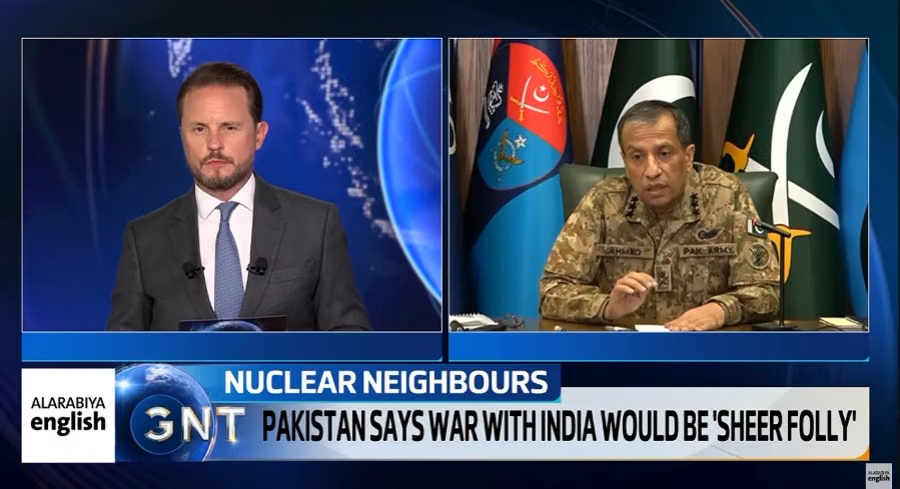
In an on-camera interview with Al Arabiya English’s Tom Burges Watson, Lieutenant General Ahmed Sharif Chaudhry, Director General of Inter-Services Public Relations (ISPR), outlined the scope of the agreement and addressed a range of regional security issues, including relations with India, Iran, the United States, and Afghanistan.
“There is nothing in this agreement which says that it is a Muslim alliance. There is nothing there,” Chaudhry said during the interview. “The objective is that it is a regional stability alliance. It is not a club that is being made for Muslim countries only.”
Chaudhry stated that the alliance aims to formalize decades of ties between Islamabad, Riyadh, and Ankara under a framework of collective defense and deterrence. He noted that other countries could potentially join in the future if all three founding members agree.
“This alliance can always encompass new willing partners who also believe in regional peace, stability and security, who have a shared vision of non-aggression, non-interference and collective deterrence,” he said. He added that the pact operates alongside each nation’s ties with other global powers, specifically China, noting that all three members maintain strong relationships with Beijing.
When asked how Pakistan would react if an allied nation faced an attack, Chaudhry declined to share specific operational protocols. He explained that operational plans for defending against aggression remain classified and are determined directly by the member governments.
The interview also covered Pakistan’s current diplomatic efforts to mediate tensions between the United States and Iran. Chaudhry described Pakistan as an “objective arbiter” and an “honest broker of peace” due to its established diplomatic ties with Washington and its shared border and strategic relations with Tehran.
“Pakistan’s political and military leadership has been reaching out to all the parties so that better sense prevails and, instead of a military solution, we come to a negotiated outcome of this very complex situation,” Chaudhry said, stating that Pakistani officials intend to keep mediating even if initial proposals face pushback.
Turning to relations with India, Chaudhry referenced a May 2025 cross-border conflict, stating that Pakistan used only 10 to 15 percent of its military capability during its response. He warned that any future military moves by New Delhi would have severe outcomes.
“If the Indians have this notion that they can again do some false flag operation, build up a narrative and try to force their will, then the result will be catastrophic for them,” Chaudhry said.
Chaudhry added that Pakistan is not pursuing an arms race with India and does not seek conflict between nuclear-armed neighbors, which he termed “sheer folly.” However, he stressed that Pakistan’s nuclear thresholds are “not for discussion” and that any official talks with New Delhi must happen on equal terms while addressing Pakistan’s security concerns.
Addressing border security along the western frontier, Chaudhry accused the Taliban-led administration in Afghanistan of permitting militant groups to operate from Afghan territory. He asserted that Pakistan retains the right to defend itself across borders under Article 51 of the United Nations Charter.
According to Chaudhry, Pakistani forces have conducted more than 42,000 intelligence-based operations so far this year, resulting in the deaths of over 2,100 suspected militants. He noted that over 32,000 of those operations took place in Balochistan, while rejecting characterizations of the unrest there as an insurgency, stating that the state remains focused on engaging everyday citizens rather than local tribal elites.