
Court Strikes Down Biden-Era EV Fuel Rule, Handing Major Win To Trump DOE
The Eighth Circuit Court of Appeals vacates the Biden-era DOE rule on electric vehicles, halting a policy designed to boost EV adoption.
A federal appeals court has delivered a significant blow to a Biden-era energy policy, siding with a coalition of 14 states and the American Free Enterprise Chamber of Commerce in a lawsuit against the government.
The Eighth Circuit Court of Appeals on Friday vacated the final rule from March 2024 that changed how the Department of Energy (DOE) calculates the “petroleum equivalency factor” (PEF)—a metric that artificially inflates the fuel economy of electric vehicles to help automakers meet federal standards.
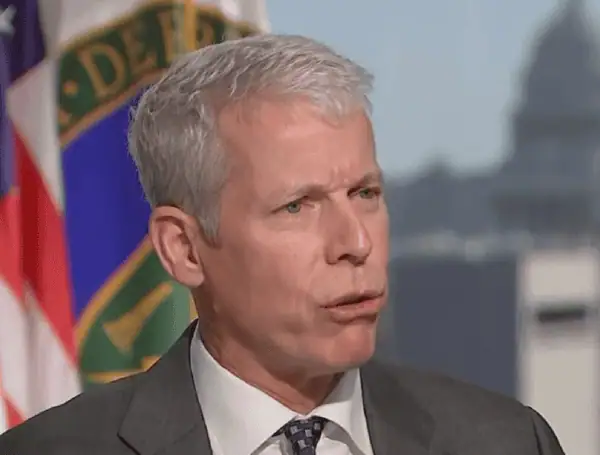
The court’s decision is a major win for the Trump administration’s DOE. Chris Wright, the current Secretary of Energy, was listed as the respondent in the case, which challenged the Biden-era regulation.
In a scathing opinion, Judge Steven Benton wrote that the Biden DOE exceeded its statutory authority by including an “unheralded” and “transformative” power that had no basis in a decades-old statute.
The court’s ruling focuses on two major issues with the DOE rule.
Unauthorized “Fuel Content Factor”
The central issue was a “fuel content factor” that has historically inflated EVs’ fuel economy by a ratio of 1/0.15. While the Biden administration’s rule sought to phase out this factor, the court ruled that its continued—and even temporary—use was an overreach.
The court found that the DOE’s justification for the factor was a “broad reading” of a statute that allows it to consider the need to conserve energy and the scarcity of fuel. The judges pointed out that this interpretation was a sharp departure from the agency’s own past practices and contradicted the plain language of the law.
They emphasized that Congress had specifically exempted electric vehicles from a similar “fuel content” rule that applied to other alternative fuels, indicating that it never intended for this type of calculation to be applied to EVs.
“DOE cannot ‘discover in a long-extant statute an unheralded power representing a transformative expansion in its regulatory authority,” the opinion said, quoting a prior Supreme Court ruling.
Violation of Notice-and-Comment Procedures
The court also found that the DOE violated the Administrative Procedure Act by failing to give the public adequate notice of a major change in its methodology.
In its proposed rule, the Biden-DOE said it would calculate the PEF for the years 2027 to 2031 by averaging out the projected state of the electrical grid for those five years. However, the final rule suddenly switched to a new methodology: factoring in the “survivability-weighted lifetime mileage schedule” of an EV fleet over 40 years. This meant the DOE would rely on projections of the grid mix and vehicle use for decades into the future.
The court found this change was not a “logical outgrowth” of the initial proposal. “DOE gave interested parties almost no idea it was considering the generation mix of the electrical grid each year over a 40-year survivability-weighted lifetime mileage schedule,” Judge Benton wrote. This denied the public and interested parties, like the states and automakers, the opportunity to offer “informed criticism and comments” on a crucial part of the rule.
By vacating the entire final rule, the court has returned the regulatory landscape to the prior 2000 rule, which still uses the inflated fuel equivalency metric. The court said it had no choice but to vacate the rule, as the two flawed components were not “severable” and were central to the agency’s rulemaking.
TAMPA FREE PRESS
Please make a small donation to the Tampa Free Press to help sustain independent journalism. Your contribution enables us to continue delivering high-quality, local, and national news coverage.
Android Users: Download our free app to stay up-to-date on the latest news.
Connect with us: Follow the Tampa Free Press on Facebook and Twitter for breaking news and updates.
Sign up: Subscribe to our free newsletter for a curated selection of top stories delivered straight to your inbox.